As a hotelier with more than 20 years’ experience across the continent, I have become acutely aware and increasingly disturbed by the value extracted from a place by tourism. Alkebulan Homes & Villas is my response to that concern.
Tourism in Africa has always carried enormous promise. It can create jobs, support local enterprise, connect cultures, and showcase the beauty of place. Yet too often, value flows out faster than it flows in. Global booking platforms take large commissions, local operators lose control of their data, and the communities that host tourism do not receive a fair share of the long-term benefit.
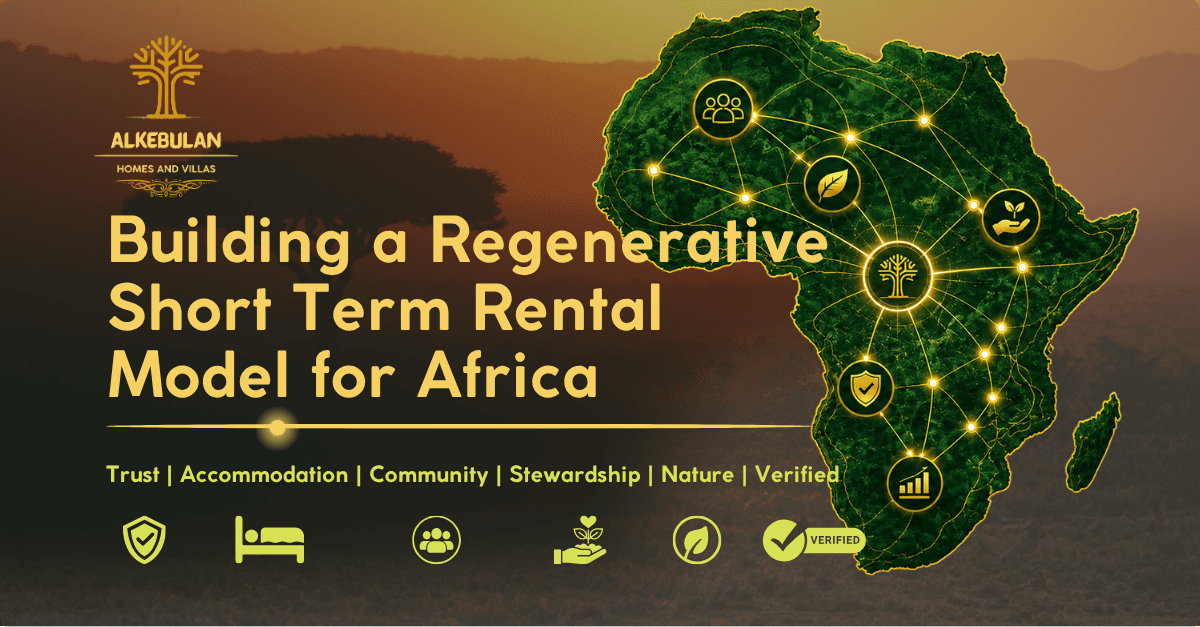
At Alkebulan Homes & Villas, the belief is that tourism needs to be rethought from the ground up. This is not about building another hospitality business that competes only on price or convenience. It is about building a regenerative tourism model rooted in trust, local ownership, verifiable impact, and African sovereignty. The aim is simple: to create a system where every stay contributes to the health of a place, the dignity of a community, and the resilience of the local economy.
This is about more than accommodation. It is about building infrastructure for a different kind of tourism economy, one where value is measured not only in revenue, but in restoration.
Why the current model is broken
Today’s tourism system is extractive in ways that are often hidden from the guest. Platforms control discovery, pricing, guest data, and payments. In many African markets, commission fees leave the continent before hosts have had a fair chance to build sustainable value. Payment processing, data ownership, and demand generation frequently sit offshore.
At the same time, tourism is often disconnected from the people and ecosystems that make a destination worth visiting in the first place. Local farmers, artisans, guides, community groups, and small property owners are not always properly integrated into the value chain. Environmental restoration is usually treated as an afterthought, if it is considered at all. In practice, this means tourism can enrich a few while placing pressure on the very places it depends on.
That needs to change.
A regenerative model
Alkebulan Homes & Villas is being proposed and designed as a Kenya-first model for short-term rentals and independent hospitality. The goal is to create a platform where every stay is both profitable and restorative, while recognising that the value exchanged between a guest and a place is not symmetrical. A couple may pay an amount that feels like good value for money to them, but the place they stay in carries staffing, maintenance, infrastructure, energy, water, cleaning, safety, and community costs that far exceed that single transaction.
That is the central tension in tourism. The guest often leaves with a strong emotional return — rest, joy, memory, status, connection, and the sense that the trip was worth far more than the cash spent. The place, by contrast, only remains healthy if enough guests come through to support the real economics of running it, while still leaving enough behind to sustain the people, systems, and ecosystems that make it possible in the first place.
Our view is that regenerative tourism must account for that imbalance honestly. It should not treat a booking or arrivals as the full measure of value. It should be designed so that what the guest receives in experience is matched by what the place receives in durable support, community benefit, and long-term stewardship.
That regeneration can take many forms. It may mean sourcing breakfast produce from regenerative farmers. It may mean funding river cleanups, tree planting, or local restoration projects. It may mean supporting community assets such as libraries, museums, or shared infrastructure. It may mean rewarding good stewardship, whether by property owners, farmers, or guest-facing partners.
Why trust matters
If tourism is to become regenerative, trust must be built into the system, not added later as a layer of branding. Guests need to know that a property is real, safe, verified, and aligned with the values it claims. Hosts need to know that guests are properly verified and that their operations can be trusted by partners, insurers, platforms, and funders. Communities need confidence that participation in tourism leads to genuine benefit, not just promises.
This is where verification matters. The model combines real-world assets, monitoring, reporting, and verification (MRV), and blockchain-based records that cannot be silently altered. In practical terms, that means property attributes, host credentials, sustainability claims, and tourism impact data can be logged in a way that creates a reliable trust layer for guests, partners, and increasingly for AI travel tools as well.
The point is not blockchain for its own sake. The point is to build an infrastructure of accountability that makes regenerative tourism credible at scale.
Tourism receipts that mean something
One of the most compelling parts of this model is the possibility of digital regenerative receipts. Imagine a guest checks out of a villa or apartment and receives more than a payment confirmation. They receive a clear, verifiable record of what their stay helped support: which farmers supplied their meals, which community projects received funding, and what was planted, measured, and retained over time.
That matters, because planting a tree is not the same as growing a healthy tree. A tree may be stunted by disease, lost in a flood, or fail to survive long after the initial announcement has been made. The platform is designed to track those outputs properly, so the story of a place is built on immutable evidence, not on claims that cannot be checked. That is what separates genuine regeneration from greenwashing.
In a recent Tourism CoLab webinar, Aline Van Moerbeke of La Casa Integral observed that the success of a place’s regeneration could be seen in an increase in pollinators. It struck me as a brilliant way to think about regenerative success, because it turns regeneration into something living and measurable rather than something simply declared. It also took me back to school projects, counting blades of grass in a square metre, and to a more sobering lesson from the UK: great crested newts have been affected by the loss and deterioration of ponds, and pollution including agricultural runoff can degrade the habitats they depend on. That is a reminder that what looks green on the surface is not always ecologically healthy underneath.
This is exactly where monitoring, reporting, and verification becomes powerful. Inputs such as these observations can be added to the blockchain, creating a richer and more truthful picture of whether a place is actually becoming healthier over time. In doing so, they can help answer questions posed within the Regenerative Pillars of Practice framework developed by Dianne Dredge and Nadine Schmidt of Tourism CoLab, which describes five regenerative capitals: Community, Economic, Place, Nature, and Systems.
It also creates an opportunity for schoolchildren to engage early as future stewards of their place, while helping to maintain and strengthen social cohesion across generations through shared observation, shared evidence, and shared responsibility. Technology is now much more affordable, portable, and advanced than when I was at school, which means capturing data can become more immersive, results more precise, and solutions identified and implemented faster. In that sense, this takes citizen science to the grassroots level, co-creating scientific value.
This also changes the psychology of travel. A stay is no longer just a transaction. It becomes a contribution. It becomes a statement of values. It becomes a visible link between spending and stewardship.
That kind of transparency will matter even more as AI travel tools become central to how people plan journeys. In the near future, conscientious travellers will increasingly ask an AI-powered assistant to book them a safe, verified, regenerative place to stay. If Africa is to be ready for that future, it must own the data, the standards, and the distribution rails those systems depend on.
Regaining tourism sovereignty
This is where the conversation becomes bigger than hospitality. The future of tourism in Africa is tied to sovereignty. If data, standards, trust systems, and booking infrastructure remain in the hands of intermediaries, then African operators will continue to depend on others to define the value of their places.
Africa should be the gatekeeper of its own tourism future. That means building systems that allow governments, hosts, businesses, and communities to participate in a more transparent and fair way. It means simplifying compliance where possible, including business licensing, tax recording, and reporting. It also means giving host governments and local institutions clearer visibility into what tourism is doing, who is benefiting, and where improvement is needed.
This is not only about efficiency. It is about power. Who gets to define quality, verify impact, and own the data that shapes demand are strategic questions, and Africa should answer them for itself.
Incentives for regeneration
A regenerative tourism model must reward the people who make it work. Farmers should be able to earn more from supply relationships and verified regenerative practices. Property owners and independent hotels should be able to build status and trust through measurable performance. Guests should be rewarded for participating in the system through regenerative badges or other forms of recognition.
There is also room for tokenisation and new revenue pathways that help capital flow back into the community. Done properly, this can support restoration projects, community development, and shared assets in a way that is transparent and participatory. The goal is not speculation. The goal is utility: turning verified contribution into practical value that helps a place grow stronger over time.
Just as importantly, the system should recognise grassroots economics. Not all value is monetary, and not every exchange needs to move through cash alone. Commoning, pooling, reciprocity, and mutual support are fundamental to resilient local economies. A builder helping with farm work in exchange for harvested produce is not a side note; it is part of the real economy of trust that already exists in many communities.
Cecilie Smith-Christensen’s work on collaborative and alternative finance suggests that this can work as does Will Ruddick’s exploration of Kenyan traditional pooling and work on Grassroots Economics. Models such as these can support resilience in the system, particularly during times of stress.
Kenya as the starting point
Kenya is the right place to pilot this vision. It is a market with strong tourism potential, a growing digital ecosystem, traditional commons and pooling communities, and an emerging set of technologies and initiatives that aim to keep more value local while supporting long-term ecological and social health.
The plan is to develop the concept to MVP level in Kenya first, working with the right blockchain host such as the Dharitri Foundation (dharitri.org), travellers, property partners, farmers, technologists, and funding partners. The technology still needs developing, and the initial model can start small, with a focused number of units, regenerative suppliers, regenerative extractors such as waste recyclers, and curated experiences. From there, the aim is to test, learn, measure impact, and scale responsibly across wider markets.
This is not a fantasy project. It is a practical framework for building hospitality infrastructure that can be measured, verified, and improved over time.
What this is really about
At its heart, Alkebulan Homes & Villas is about creating a new relationship between tourism and place. The ambition is to move from extraction to regeneration, from opacity to verifiable transparency, and from dependency to African-led infrastructure.
With the right mindset, the right partners, and the right funding, tourism can become one of the most powerful tools for restoring communities and landscapes while creating dignified economic opportunity.
The future of tourism should not be measured only by occupancy rates or gross bookings. It should also be measured by soil health, local income, community resilience, trust, and the quality of life it helps sustain. That is the future Alkebulan Homes & Villas is trying to build within its small corner of the travel and tourism market.