
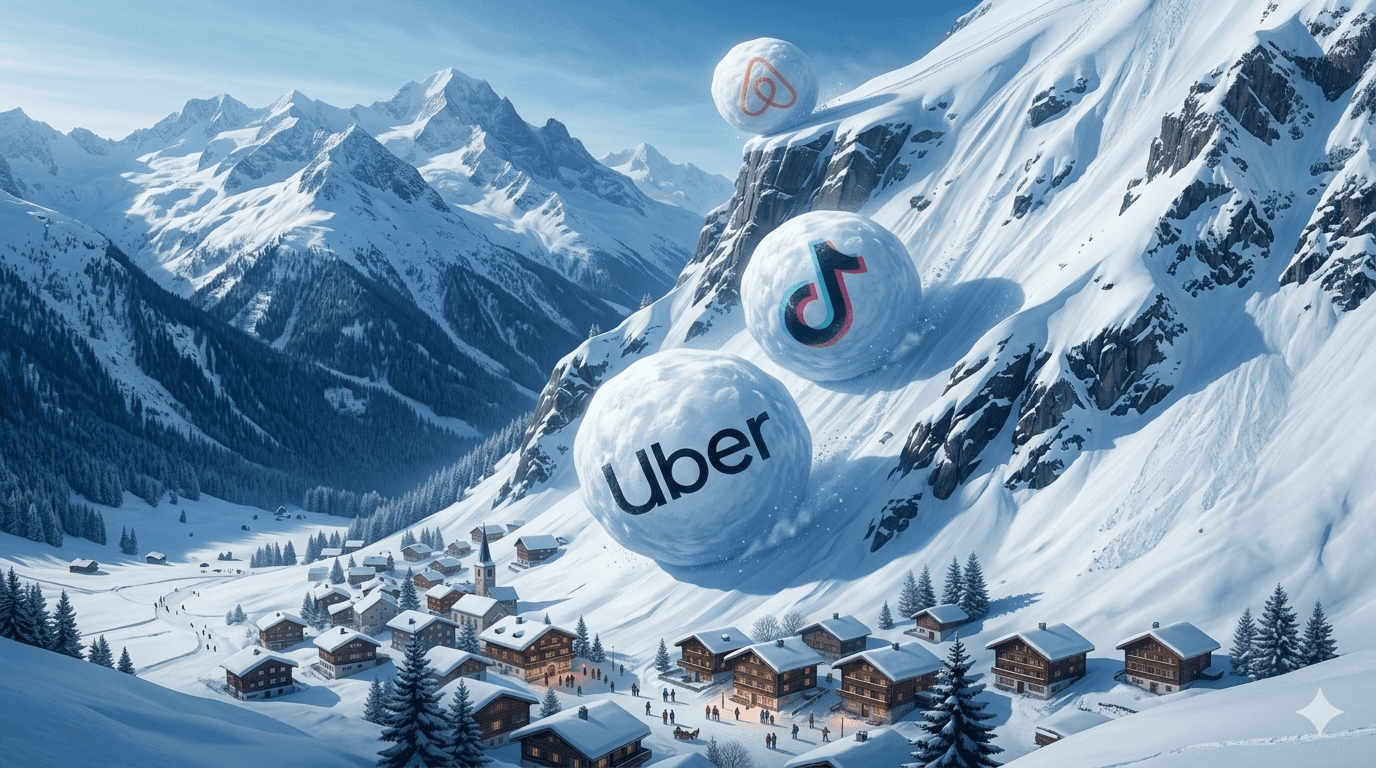
Trust is claimed by the app, but the risk and reality are left with the host.
The snowball of super-app bookings
On 20 April, Uber announced that it was partnering with Expedia to offer accommodation through its app. Although the rollout is for the US market, the listings draw on worldwide supply, including short-term rentals from VRBO. When that news dropped, I knew I had to write something. At the time I was busy writing the KYC article, so I didn’t have the bandwidth to deal with it. In hindsight, that may have been a good thing, because TikTok has now joined the programme and launched TikTok GO on 12 May.
TikTok GO allows users to book hotels, tours, and experiences directly from short-form travel videos, powered by Expedia, booking, Viator, and others. Three weeks into writing this article, Airbnb has also announced its summer release. Things are moving so fast in this sector that it feels like we’re disappearing into a singularity.
This feels like a snowball rolling down a hill.
Uber and TikTok are the first two platforms to announce this, and the rest of the API-driven OTA ecosystem could start tumbling behind them. My prediction is that Meta will be next — a possibility also raised in Skift’s “Every App Wants Your Booking. Nobody’s Cracked It Yet.”
What super apps are doing
Many of us know apps like Uber already aggregate transport, food, groceries, payments, and now accommodation — at least in the US market. Your relationship is with the app, not with the service provider. Communications and transactions go through the app, not the provider, so you end up locked into a system that can sit further and further away from the point of sale. Expedia’s Rapid API is built exactly for this kind of redistribution — “build your own travel experience” using its 700,000 properties across 250,000 destinations.
Imagine the guest journey now: you plan your trip in one app, book your accommodation there, arrange the ride from the airport to the hotel, order food, buy groceries, and visit places of interest — all through the same interface.
That’s the promise, at least.
But what happens to communication with the hotel or apartment? It likely happens through the app too, which removes you further from the relationship with the accommodation provider. The accommodation becomes just another node in the data flow. And when accommodation is supposed to be frictionless with KYC bolted on, the real question is whether it will actually be frictionless. Time, and guest reviews, will answer that.
Why this is commoditisation, not just convenience
This phenomenon makes properties interchangeable and generic — living inside a UI rather than a much-loved property or branded experience — and operators have little control over that. Pricing, presentation, filters, and loyalty are all owned by the platform, putting you further away from the guest, not closer.
The trust is in the interface; the bed is just anonymous inventory.
On the Skift broadcast, I commented that maybe a term for this would be “memebooking” — accommodation is now so abstract that it can be inserted into any app as a swipeable, throwaway product — only to learn from another attendee that the term had already been in use since around November last year. Ha. I was clearly suffering from cryptomnesia. The more platforms that can do this, the more accommodation becomes a commodity, not a hospitality experience.
Consent and the “fuzzy” permissions question
When a hotel or STR signs a contract with an OTA, did they sign up to be sold inside Uber, TikTok, and others, or just to be listed on the OTA’s own channels? Is our product being transformed into something like a Tinder or Grindr profile, to be swiped into or out of existence?
I’m sure some hosts will see this as a great opportunity to reach a wider audience, though many will see it as a vanity project. I wonder how many hosts genuinely consent to this platforming move.
It feels like property capture by API — the keys that let third-party apps build on top of OTA inventory — with the host several steps removed from the final booking interface. Many owners and property managers won’t want their property surfaced and bookable in this manner, because it dilutes the brand, masks the listing content, and makes the whole journey feel superficial.
Guests trust the super app, but the host is the one washing the sheets, testing the smoke detector, and checking ID.
That’s the trust gap. And it’s this trust gap we need to plug.
KYC, guest safety, and “who actually cares”
In my “Trust is the new currency” article, I argued that trust can redirect tourism revenue to the real hosts and communities.
The super-app move is the opposite of where we want to be — the trust is claimed in the app, but the real KYC, risk, safety, and duty of care sit with the local host, the guard, the landlord, and the community. Short-term-rental-linked incidents and the regulatory reaction that followed may have made the booking process more visible, but they have not made it easier.
As hosts and Property Management Companies (PMCs) move towards tighter KYC, the path to booking gets slower and more demanding, with ID checks, CCTV, logs, and verification all adding friction. That friction is necessary — the need for better governance in the STR sector is as important now as ever, in an industry that scaled faster than it could govern itself.
But it also makes you wonder whether memebooking loses some of its shine once compliance and accountability enter the room. In this new move, who is the real “trust bearer” when the guest is booked in Uber or TikTok but checked into a Nairobi STR that retains ID logs and CCTV as part of it's due diligence?
In which direction does the trust move, and where does the OTA sit in this relationship?
The “new era of trust” and the local counter-play
Within the wider “AI/agent economy” narrative, trust is the new currency — the reserve asset — and platforms are fighting to own it. If we keep outsourcing that, they will assume ownership. Super apps are placing trust in the interface, not in the real-world operator.
They don’t carry the reputational risk of the host or the enforcement cost of the regulator. If trust is the new currency, then local, visible, accountable hosting is the real mint. That means registration, KYC, clear host identity, and strong direct relationships — even if you are also on the platforms.
Local, human-scale, visible trust
If you’re an operator today, the question is not “Can I get a booking on Uber and TikTok?”, but “Can I become the kind of trust-wrapped host that even the super apps have to recognise and respect?” That should be possible if we self-enforce regulator-friendly registration, rock-solid KYC, real host identity, and community-anchored standards — the opposite of anonymous, API-driven inventory.
Because in the end, the snowball may be rolling, but the real leverage is still local, human-scale, and visible trust.
At Alkebulan Homes & Villas, we help owners prepare and manage short-term rentals with the right systems, standards, and support in place from the start. If you are considering professional short-term rental management or want advice on getting your property market-ready, speak to us.